
PROEXPORT / INDUSTRIAL ROLLERS
Rubber-Covered Industrial Rollers | PROEXPORT
PROEXPORT rubber-covered rollers are precision industrial components engineered for conveying, pressing, lacquering, and laminating lines. They provide controlled elastic compliance, high traction friction, and chemical resistance against process fluids (oils, solvents, water, adhesives). Compound selection is governed by actual operational chemistry, thermal load, and linear nip pressure rather than nominal Shore A hardness alone.
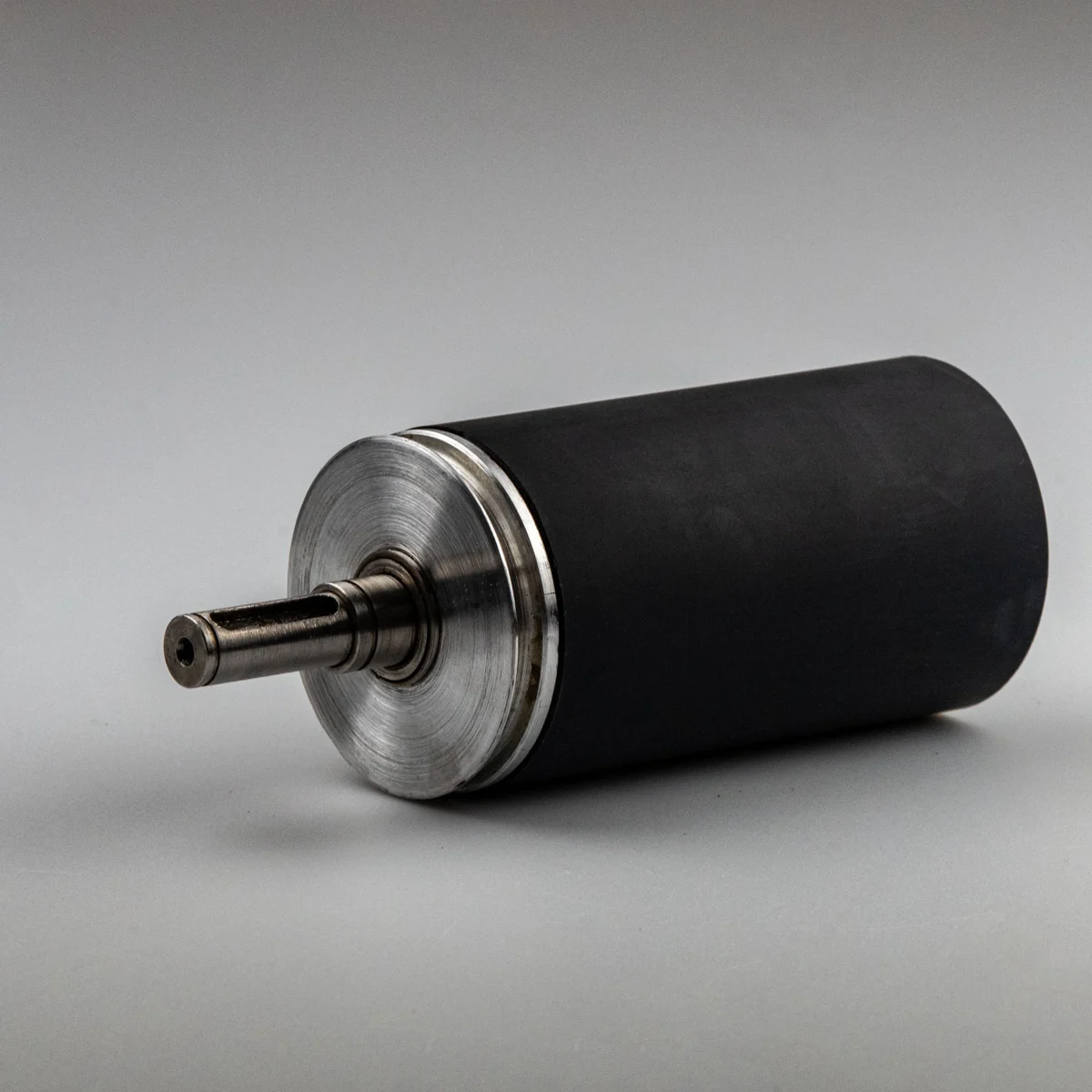
TECHNICAL SPECIFICATIONS
Manufacturing Parameters and Operating Tolerances
We match core construction, elastomer compound or metallic coating, and surface finish directly to the operating conditions on your line.
| Technical Parameter | Specification / PROEXPORT Standard |
|---|---|
| Hardness Range | 20 to 95 Shore A (from soft applicators to rigid nip rollers) |
| Available Polymers | NBR (nitrile), EPDM, NR (natural rubber), SBR, CR (Neoprene), CSM (Hypalon), FKM (Viton®), silicone |
| Covering Thickness | Standard 5 to 30 mm on radius (custom according to drawings) |
| Max Dimensions | Diameter up to Ø1600 mm, overall length up to 6000 mm |
| Operating Temperature | Continuous from -30°C to +140°C (depending on elastomer formulation) |
| Precision & Balancing | Cylindrical grinding within ±0.02 mm, dynamic balancing ISO 1940 G2.5 / G6.3 |
LINE PROBLEM SOLVING (PWE)
Precision that Eliminates Line Downtime and Web Defects
At PROEXPORT, we do not simply supply coatings — we solve specific engineering challenges for plant technologists and maintenance leaders.
PRODUCTION CHALLENGE
Line Issue
Excessive swelling, surface softening, or premature cracking under exposure to solvents, oils, and aggressive wash media.
PROEXPORT SOLUTION
Engineering Solution
Application-specific compounding (e.g. hydrogenated NBR or high-density EPDM) bonded chemically via hot vulcanization primers.
PLANT ROI RESULT
Measurable Effect
Up to 3x longer service intervals between regrinds, stable nip width, and elimination of unscheduled line shutdowns.
SELECTION & QUALITY CONTROL
Pre-Production Specification & Quality Inspection
Every project — new fabrication or reconditioning — is executed according to strictly defined inspection points:
- Shore A hardness verified at multiple points along the roller face (DIN ISO 7619-1).
- Concentricity, cylindrical runout, and journal runout measured with dial indicators.
- Dynamic balancing certificate according to ISO 1940-1 (standard G2.5 or G1.0 upon request).
- Bonding adhesion verified against core substrate (DIN 53531).
Technical Acceptance Standards
| Inspection Dimension | Technical Significance |
|---|---|
| Geometry & Tolerances | Diameter calibration, radial/axial runout, and concentricity of bearing journals. |
| Coating Structure | Durometer Shore/HV verification, nominal thickness, and zero-porosity bonding. |
| Dynamic Balancing | Residual unbalance compensation in ISO 1940 Grade G 2.5 or G 6.3. |
FREQUENTLY ASKED QUESTIONS (FAQ)
Frequently Asked Questions (FAQ)
How to specify the correct rubber compound for an industrial roller?
Provide operating temperature, linear nip pressure, surface speed, and full safety data sheets (SDS) of all process liquids and wash solvents. We select the formulation to match chemical and thermal demands.
Can a worn rubber-covered roller be refurbished instead of replaced?
Yes. Complete refurbishment includes stripping the degraded covering, inspecting journal tolerances, shot blasting the core, applying bonding primers, hot vulcanization, precision grinding, and dynamic balancing.
PROEXPORT / INDUSTRIAL ROLLERS
From technical drawing to line-ready solution.
Submit dimensions, photos, and operating conditions. We will determine the optimal manufacturing or reconditioning scope.